Other Places


Web Portal~>

"Awen yn codi o'r cudd, yn cydio'r cwbl"
- Waldo Williams
(Awen arising from hiding, everything binding)


Showing posts with label David Jones. Show all posts

Artio to Arthur - The Path to Caerleon


As well as being a poem which presents the landscape of Britain using Welsh words as signifiers, The Sleeping Lord presents a landscape which contains the 'Sleeping Lord' of its title not simply in the traditional legendary sense of him lying asleep somewhere beneath it awaiting the hour of need for his return, but as the poem's concluding series of questions has it:


Are the slumbering valleys

                                him in slumber

                                are the still undulations

the still limbs of him sleeping?

Is the configuration of the land

                                the furrowed body of the lord

are the scarred ridges

                                his dented greaves

do the trickling gullies

                                yet drain his hog-wounds?

Does the land wait the sleeping lord

                                or is the wasted land

that very lord who sleeps?


This represents Arthur very differently from the view of him as the Romano-British 'Director of Toil' in the fight against Saxon invaders, different even from the early Welsh representation of him as the chief of a band of adventurers who interact with giants, witches and magical  adversaries. It is in absolute distinction to the 'king' of later medieval romance. Rather it presents him as a chthonic embodiment of the land itself, sleeping not beneath it but as the land sleeps in winter or when it is 'wasted'. In other parts of the writing, particularly in the central section, set out as prose rather than verse, Arthur's legendary attributes are evoked. But in both the beginning and the end of the piece he appears as the land itself: "his bed deep on the folded strata". Yet this is a poisoned land, wasted in ways that even a Brythonic warrior cannot have imagined:


Is the Usk a drain for his gleaming tears

who weeps for the land

who dreams his bitter dream

for the folk of the land

does Tawe clog for his sorrows

do the parallel dark-seam drainers

mingle his anguish-stream

with the scored valleys’ tilted refuse?


A similar, though more briefly sketched, view of Arthur in this light also appears in the shorter fragment 'The Hunt', based on the boar hunt in Culhwch and Olwen: "was he riding the forest-ride or was the tangled forest riding?". There is a quite startling development of this when it is suggested of "the bleeding man in the green", as he turns to meet the riders who follow him and their eyes meet, that "it would be difficult to speak of so extreme a metamorphosis", as if only then does his humanity return.


This is the ground of his being. In spite of his own attachment to the Christian mythos, David Jones suggests, in a long essay on 'The Myth of Arthur’,(1) that Arthur’s origins might be found not in a defender of Romanitas, but farther back in an Iron Age bear goddess. His appellation of Arthur as 'the Bear of the Island' conflates this sense of him as a warrior of wild-animal ferocity (a common feature of heroic poetry) with a sense of his origins as an actual bear deity. The discussion of him in the essay references Gaulish inscriptions of a male bear god Artaius and a female deity Artio and suggests that the bear might have been a totem animal for the earlier Gaulish tribes and that "the hero god may later have become associated with Arthur the man-hero". He notes that there are other precedents for agricultural deities becoming gods of war, and that this was so for the early development of the Roman Mars. A bronze statue of the goddess Artio was much more recently shown in the exhibition 'The Celts' which toured Britain a few years ago. It has the inscription 'To the Goddess Artio, dedicated by Licinia Sabinilla'.
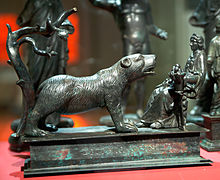

https://en.wikipedia.org/wiki/Artio


What is particularly interesting about this statue  is that the exhibition catalogue notes that the human figure is a later addition and that the statue was originally just the bear figure (2). The assumption is that the addition occurred when the statue was acquired for use in the Romanised Gaulish villa where it was found. This suggests that the original statue reflected an earlier practice of representing the deity in animal form, but that this was unacceptable to the romanised individual who acquired it so the human figure was added. The statue was found in northern Gaul. Inscriptions to the male god Artaius are recorded mainly in the south which was romanised earlier. One reads  "to Holy and August Artaius".(3) Was there a male and female pair of bear deities or, as David Jones suggests, did one develop into the other? A shift, that is, from female to male and then on from animal to humanised deity.


If so, how might a bear goddess and god, recorded in epigraphy and iconography in Gaul, become the Arthur of British tradition? Clearly bear deities did not fit well with the tendency of the Romans to assimilate Celtic deities to their own pantheon, but these bear deities are attested and did survive Romanisation, at least for a time. So when a heroic figure resisting the Saxons is commemorated in the ninth century Welsh-Latin Historia Brittonum with the same  'Arth-' (bear) stem to his name, and as such a name is not common, it is worth asking where this name might have come from. It also  the case that the name Arthur is attached to a figure in early folklore in Welsh which feeds into such literary manifestations as the tale Culhwch and Olwen, an Arthurian story which predates the appearance of Geoffrey of Monmouth's shaping of Arthur in his 'History'. Surveying early Arthurian literature in Welsh, O J Padel has written; "the Arthur of local legends and magical animals is the dominant one until the 12th century, when the military one becomes prominent". (4) This early Welsh Arthur was a leader of a group of rugged and often themselves magical individuals rather than a 'king'. Padel compares them variously to Robin Hood's band and the Fianna under Finn in Ireland. In this context it is easier to see how such a view of the emergence of Arthur from a bear deity, and such a representation of him as the Green Man or a chthonic Sleeping Lord, begins to make sense.


Arthur's continuing presence in folklore as a giant should also be borne in mind, as should the legend that his wife Gwenhwyfar was the daughter of a giant. This view of him seems to have easily survived his translation to the king of medieval romance and seems to be persistent from earlier traditions. It is reflected in many landscape features such as 'Arthur's Seat', suggesting a giant-sized occupant; there are many cromlechs, other megaliths and large rocks citing Arthur in their name or with a legend connecting him to them. Other members of Arthur's retinue such as Gawain are also credited with gigantic stature(5).  In Culhwch and Olwen the ‘chief giant’ Ysbaddaden Pencawr says that Arthur is one of his men although he is helping Culhwch to fulfil the task that Ysbaddaden has set for him. It is easy to see how a folklore giant who becomes human might later be portrayed as confronting or otherwise dealing with giants. Arthur's dog is called Cafall (horse) making it a suitable sized dog for a giant.


All of which underlines the metamorphic nature of mythic narratives, legends and folk memory. Though contexts and forms of representation might change, the underlying figure remains. The sequence "Bear - Goddess - God of the Soil - God of Weapons - Romano-British General - Christian King..." (6) suggests that we make what we will of what has come down to us from the storehouse of our mythic life. It’s a long way from bear deity/giant/chthonic-sleeper to the ‘Dux Bellorum’ of Roman Caerleon and then on to the ‘king’ of medieval romance.  Many accretions have been accumulated on the way. The task, then, to conclude with David Jones: “ ... is to make significant for the present what the past holds  ..... this is the function of genuine myth, neither pedantic nor popularizing, not indifferent to scholarship, nor antiquarian, but saying always ‘of these that thou hast given me have I lost none’.” (6)


 All verse quotations from David Jones The Sleeping Lord (Faber, 1974)


Other references:

  1. David Jones  ‘The Myth of Arthur’ in Epoch and Artist (Faber, 1959)
  2. CELTS : Art and Identity Exhibition catalogue (British Museum, 2015)
  3. Inscription from Beaucroissant CIL 12, 02199, referencing Mercury together with Artaio dedicated by Sextus Genius Cupitus
  4. O J Padel Arthur in Medieval Welsh Literature  (University of Wales Press, 2000)
  5. William of Malmesbury mentions an outsize grave of Gawain in the 1120’s. Many references to Arthur as a giant also occur in Chris Grooms The Giants of Wales/Cewri Cymru (Lampeter, 1993)
  6. David Jones ‘The Myth of Arthur’ in Epoch and Artist (Faber, 1959)


David Jones' The Sleeping Lord - A Bilingual Poem?


Is it possible to write a bilingual poem? I don't mean a poem with an accompanying translation by the poet, but one that is written in one language but contains elements of another language embedded in it. Nor am I even thinking of a situation where a writer inhabits a fully bilingual culture and can depend upon both languages being understood by readers of the poem, as, for instance, a poem written mainly in Welsh but containing words or phrases in English.  I want to look at an example of the reverse of that situation: a poem written in English but containing words and phrases in Welsh and published for a readership that includes many with little or no knowledge of the Welsh language.  To write such a poem is both a creative endeavour, exploring the limits of bilingual expression, and a statement of cultural affiliation, placing the poem within a tradition that has its main expression in the Welsh language. A poem which sets out to do this is David Jones' The Sleeping Lord. Much of his writing incorporates elements of Latin as well as Welsh into the main language of English. But parts of The Sleeping Lord contain a density of Welsh words that begins to convey the impression of Welsh as the poem's paralanguage and main tonal register. 

One of David Jones earliest interpreters, his friend René Hague, expressed reservations about this aspect of his poetry: "His ingenious use of Welsh words as though they had some magical quality reminds one of the Saxon invader in The Anathemata who will "Latin runes tellan....." [1]  Another interpreter, Roland Mathias, offers a lengthy rebuttal of this claim in general terms with better understanding of the Welsh context, but does not offer a specific analysis of the linguistic issues.[2]  It is not that the structure of the language used is Welsh. The words used are almost all nouns or short noun phrases. They are often placed in the text so as to take the primary stress both in passages of verse and in passages of prose. So, in The Sleeping Lord,

It is the great ysgithrau of the Porcus Troit that have stove in the wattled walls of the white dwellings, it is he who has stamped out the seed of fire,  shattered the pentan-stone within the dwellings; strewn the green leaf-bright limbs with the broken white limbs of the folk of the dwellings, so that the life-sap of the flowers of the forest mingles the dark life-sap of the  fair bodies of the men who stood in the trackway of the long tusked great hog, y twrch dirfawr ysgithrog hir. [3]

In terms of the number of words the use of Welsh here is not great. But  Welsh words carry the  English sentence's simple base structure and foregrounded subject: 'It is the the great ysgithrau of the twrch dirfawr that has done this'. The foregrounding of important imagery is a characteristic strategy of David Jones' visual  art as well as his writing. marking points of symbolic detail in a tangle of variety that is the whole.  Here the figure of the legendary hog stands out from the text with the vividness of similar foregrounded figures in his paintings. Seen in this way the use of the Welsh words is as much a matter of technique as it is of cultural affiliation, or rather the two are wedded in a way that René Hague's comment indicates that he was oblivious to. 

Elsewhere in the poem Welsh occurs with Latin in long lists or, as below, in a series of reference points in the natural landscape:


and the resistant limbs

of the tough gnarled derwen even

lean to all the briary-tangle

that shelters low

in the deeps of the valley-wood

the fragile blodyn-y-gwynt.

And the wind gusts do not slacken

but buffet stronger and more chill

as dusk deepens

over the high gwaundir

and below in the glynnoedd

where the nentydd run

to conflow with the afon

where too is the running of the deer

whose desire is towards these water brooks.


It is quite true that words are used here, as Hague puts it "as though they had some magical quality". It is also, perhaps, possible to understand why some might not appreciate their function of making the fine detail of the natural landscape specific to a particular place, though it seems to me that, however artful their placing here, they vividly capture that natural landscape in a way that English words would not, and so form the natural ground of the artifice of the poem. Those responding positively to the full resonances of these very specific landscape indicators will not object to Hague's ascription of magical qualities to them. But his "as though" seems strangely wide of the mark. To the reader without some knowledge of Welsh they may appear 'runic', and some have appreciated them at that level. But this characteristic is removed, even for the English monoglot, with careful reading and an easily acquired familiarity with the meanings of the words. Such a reader will be able to follow the rhythms of the lines, taking in the richness of their specifity. It is the skill with which they are woven-in that will appeal, as much as that they stand out. David jones worked assiduously at the careful placing of significant words and would have taken particular care with these Welsh words to ensure their effect and that they were correctly used. The words themselves came to him not because he was in any way a fluent speaker of Welsh, but as a result of his extensive reading and his attempts to learn the language. He told the poet Vernon Watkins: "When I write these names in the stuff I've tried to make they come naturally because by accident I've for long been interested in what they signify in English translations." [4]

If they also have an incantatory function this is consonant with the author's view of works of art as things "made over" to the gods, giving them a prayer-like function. It is also meant to evoke a complex of associations both with the landscape and with ancestral cultures of the Island of Britain. But he also had a sense of the inherited presence of these cultural references ebbing away. He never expected all of his readers to understand Welsh, but he did hope that the references to Y Twrch Trwyth, Rhiannon, Ceridwen and other names might mean something in the way that references to Classical or Biblical mythology are more commonly used in order to convey the range of associations that go with the act of their naming. In one sense this seems to be a different issue from the use of Welsh words or phrases other than proper nouns. But the act of naming is an attempt at resonance. Using the Welsh word for oak tree (derwen), the fragile wood anenome (blodyn-y-gwynt), meadowland (gwaundir) and streams (nentydd) running into the river (afon) names all the markers of landscape in Welsh giving way only in the final line to 'water brooks'. The English narrative fills in the details of the Welsh scene, the still remaining features of Ynys Prydain inhabited now by speakers of English but the landscape itself singing 'yma o hyd' (still here).

So Welsh words form an outline that is inevitably filled-in in English. They represent an attempt by a writer with little Welsh but that he was able to acquire by extensive reading to firmly identify with the language and its associated culture as well as to affirm the continued presence of the historical roots of that culture in the landscape. One finds no such attempt by many of his near contemporaries among the English-language writers of Wales, although many of them came from Welsh-speaking backgrounds. A fair sprinkling of Welsh place names may appear, or an occasional short quotation in Welsh at the head of an English text, but nothing like the structural reinforcement of English sentences with Welsh substantives that we find in the work of David Jones.


~*~

This post is adapted from a piece I wrote in the journal 

Materion Dwyieithog/Bilingual Matters 2, 1990 pp.7-9 

~*~

References

[1]  René Hague (ed) Dai Greatcoat (Faber, 1980) p.24

[2] Roland Mathias  A Ride Through the Wood (Seren, 1985)

[3] David Jones The Sleeping Lord  (Faber, 1974)

[4] David Jones (ed. Ruth Pryor) Letters to Vernon Watkins (University of Wales Press, 1976)


Poems as Stone Circles


​In the Foreword to The Burning Tree, his collection of early Welsh poems and parallel text translations (*), Gwyn Williams  argues that the structural patterns of cynghanedd and other features of Welsh literature are distinguishable from literature in English in the same way that Celtic art forms, with their interwoven patterns, are different from artistic practices based on a clear linear form and consecutive presentation. Where there is no no single centre of focus, but rather a number of juxtaposed focal points, what happens in a corner is as important as what happens between the corners. So any sense of a ‘centre’ is spatially dispersed. Often, themes or images are linked in ways which might appear to be incongruous, but in fact reflect a different way of seeing things in relation to each other. This, Gwyn Williams maintains, “distinguishes Dafydd ap Gwilym from Chaucer, John Donne from Ben Jonson, Dylan Thomas from W H Auden”. It is a distinction that  arises from “a different view of composition” from that usually found in writing in English based on precepts taken from Greek and Latin. But, he says, the early Welsh poets “were not trying to write poems that would read like Greek temples or Gothic cathedrals but, rather, like stone circles or the contour-following rings of the forts from which they fought, with hidden ways slipping from one to another.” 

For a modern example in English he cites the prologue to Dylan Thomas’s Collected Poems which is constructed of 52 lines of verse with a returning rhyme scheme radiating backwards and forwards from a rhyming couplet at its centre. Dylan Thomas wrote this apparently spontaneously under a late deadline pressure after failing to meet the publisher’s request for the expected prose prologue.  Gwyn Williams finds the technique to be most consciously adopted in modern practice in English in the work of David Jones (whose long poem The Anathemata can be seen as structured in just that contoured way with ‘hidden’ links between spatially remote sections - see my post on his work HERE). Gwyn Williams also suggests that such effects can be observed in David Jones’ visual art, in which “a dimension is created which is unachievable in the classical convention”.

Vexilla Regis
David Jones : Vexilla Regis, Pencil & Watercolour

As if to return the compliment of this praise for his work, David Jones is known to have used Gwyn Williams’ book in his own studies of early Welsh poetry. His copy of it, now housed with the rest of his books in an archive in The National Library of Wales (**), contains annotations to aid his own interpretation of the medieval Welsh texts, in particular of the
Marwnad for Llywelyn ap Gruffudd which David Jones used for his painted inscription beginning Cara Wallia Derelicta:


Discussed HERE


Many years after the publication of that book, Gwyn Williams approached me to ask if I would be interested in publishing an article by him in The Anglo-Welsh Review, a journal of which I was then the editor. The article was entitled ‘The Paganism of Welsh Poetry’ (***) and it in he develops further his view of the distinctiveness of poetry in Welsh, this time in its subject matter rather than its formal structure. It may be a surprising assertion to some, given the amount of religious poetry that exists in Welsh, and the prevalence of the chapel in the social life of Wales in the nineteenth and early twentieth centuries. But his contention is that the spirit of Welsh poetry remained essentially pagan through the medieval period and beyond to the present. He cites “the delight in flowers, in birds, in the sea in its many moods, in wine and dancing, in love and sex, in the glory of the world…”. He sees a perceived closeness to Annwn, the Other World, as being more apparent than a perception of Heaven or Hell, and a sense of it being present in the natural world, and of  being able to inhabit it without going to a place of formal worship.  Dafydd ap Gwilym, he reminds us, often uses the language of the Church to celebrate a delight in nature as in his ‘Woodland Mass’. He finds the same emphasis in the urge to transcend time, asserting “what we have been conditioned to think of as past and even future is with us now, in this present redistribution of the human elements and in this marvellous world about us, a world our Welsh poets have spectacularly glorified.”

Like a slip-knot, a diversion in an interlaced design, a hidden corner of a landscape, a diverted path between those contour-following rings, time also slips, stills, falls through a barely-perceived gap, so that past and future are present in Annwn and here with us in the shared insight of the awenydd’s craft of shaping.


§

(*) The Burning Tree : Poems from the First Thousand Years of Welsh Verse, Selected and translated by Gwyn Williams (Faber, 1956)
(**) I spent many days browsing these often annotated books while a post-graduate student working on David Jones.
(***) ‘The Paganism of Welsh Poetry’ by Gwyn Williams The Anglo-Welsh Review No. 75, 1984, pp.70-80.

Labyrinth, Maze and Maypole


David Jones’ epic poem The Anathémata is structured as a series of circles or parenthetical sections radiating out from a centre encompassing layers of history and prehistory, also forming a circular structure that ends where it begins. His reading of Jackson Knight’s Cumaean Gates provided him with an ancient source for the practice of creating troia or maze patterns in sites such as Troy as magical defences and for the sign-containing properties of such structures. The may-pole is one way of visualising the central space of The Anathémata around which the whole poem turns. It is implied rather than explicit in that poem, which centres on the monologue of The Lady of the Pool, a tutelary deity of sorts. But in reply to a query from Jackson Knight following the publication of The Anathémata in 1952, David Jones wrote that “It has a central theme, a mythos & it circles round that central theme, if it has a ‘plot’ it’s in the sense that the dance around the may-pole plots itself in patterns round the central arbor.”(1)

Such principles are revealed, not only in the grand scale concentric designs of David Jones’ longer works, but also in middle-length poems such as ‘The Tutelar of the Place’ in which the may-pole dance within a labyrinthine defensive structure is more explicit and is symbolically opposed to the square grids of the ‘World Plan’. 

‘The Tutelar of the Place’ is set in a Celtic province of the Roman Empire, the may-pole dancers seek “hidden grammar” as part of the rite of the seasonal festival for the Goddess:

 Gathering all things in, twining each bruised stem to the swaying trellis of the dance, the dance about the sawn lode-stake on the hill where the hidden stillness is at the core of struggle …

The Goddess or the Tutelar is first evoked as Tellus, the Roman Earth Mother, “of the myriad names” but here “she answers Jac o’ the Tump only if he call Great Jill-of-the-tump-that-bare-me”. Later she is addressed as “Mair”, using the Welsh name of Mary to underline the poet’s sense of continuity between ancient rite and his own catholicism. This takes place in the prayer that follows the dance, and which asks the Goddess to protect the settlement:

…..
 mother of particular perfections
queen of otherness
    mistress of asymmetry
   patroness of things counter, parti, pied, several
   protectress of things known and handled
   help of things familiar and small
wardress of the secret crevices
of things wrapped and hidden 
   mediatrix of all the deposits
margravine of the troia
   empress of the labyrinth 
receive our prayers.

The prayer counterbalances the values of locality and identity against those of centralised uniformity characterised in the image of the Ram:

… 
  set up the hedges of illusion around some remnant of us, twine the wattles of mist, 
  white-web a Gwydion-hedge
like fog on the bryniau
against the commissioners
  and assessors bearing the writs of the Ram to square the world-floor and number the tribes  and write down the secret things by which we are ….

So the dance enacts this prayer  as it continues:

  Sweet Mair devise a mazy-guard
  in and out and round about
  double-dance defences
  countermure and echelon meanders round
  the holy mound
                                 fence within the fence
….

The may-pole dance between Jac and Jill - weaving the language of nursery rhyme into elements of folk custom and the ritual fertility dance and setting them with both Latinate and Welsh phraseology woven through the English of the text - creates a sense of tribal locality within the wider globalism of the Roman Empire. But it also employs ancient motifs of the labyrinth as a protective structure enclosing settlements, often involving a virgin goddess or priestesses, which David Jones found in the works of Jackson Knight. The dance, like the prayer, weaves a magical "fence within the fence" around the settlement. But the dance is also the nuptial rite of the Goddess and her consort, guaranteeing the stability of the tribe. So the may-pole dance, the maze, the labyrinth, contain within them the contrary elements both of an open fertility rite, and a closing of the defensive structures symbolised by virginity. David Jones said of The Lady of the Pool in The Anathémata that she is both an Aphrodite and an Athene figure. 

The way into the labyrinth is not through an impenetrable gate but through the dance which finds a way when properly enacted.  Of such contraries and inter-connections is the mythos constructed. 

~*~

David Jones The Anathémata  (Faber 1952)
David Jones The Tutelar of the Place in The Sleeping Lord (Faber 1974)
W. F Jackson Knight Cumaean Gates (Oxford,1936) Re-published together with Vergil’s Troy as Vergil : Epic and Anthropology (Unwin, 1967)
(1) Letter to Jackson Knight. Quoted by Thomas Dilworth in Reading David Jones (Cardiff, 2008) p.181

Cara Wallia Derelicta


The inscription above by David Jones is in a mixture of Welsh and Latin. It reads
Cara Wallia derelicta....Literally 'Dear, abandoned Wales' (though David Jones himself once rendered it 'Poor buggered-up Wales'), 'on the feast day of Damaseus, Friday the Eleventh day of December, then was all Wales cast down' (the last bit of that is a line from the Elegy  to Llywelyn the Last native Prince of Wales who was killed on that day). The inscription goes on to suggest a lineage for Llywelyn such as that claimed by Geoffrey of Monmouth for Arthur, but using the Latin of Virgil mixed with the Welsh of Gruffudd ap yr Ynad Coch:

The ineluctable hour of Troy has come
A leader's head, a dragon's head was upon him
Fair Llywelyn's head, a shock to the world
That an iron stake has pierced it.

(Llywelyn's body was buried at Abbey Cwm Hir in Wales but his head was impaled on London Bridge.)

And then, still echoing the Elegy from Llywelyn's bard:

'There is no counsel, no closure, no opening' (this running up the side of the inscription).

So here, on the 'first day after ten' of December, this is in memory of that winter - ab hieme - 1282.


*
Light ebbs yet, and the turn of a tide is slow, but certain.


Poetry and the Visual


The current issue of Poetry Wales magazine is a special ‘Poetry and the Visual’ edition. My contribution ‘Tide’ is jostled by an array of concrete, visual and conceptual poems. The magazine’s editor, Zoë Skoulding, comments that “all language takes on a visual shape …..the emphasis here might be what happens when we start to look at the poem rather than through it.” The magazine also contains some featured essays on links between poetry and the visual arts and the way words can interact with images. The artist Iwan Bala, who likes to place text in his visual constructions, observes that this questions the notion of the transparency of the visual image: “Having words in there adds layers, particularly if those words are used in Welsh, and therefore probably hermetic to a majority of viewers. They become marks, scribbles – a secret language.”

This is similar to a point which was also made by the poet and artist David Jones whose painted lettering used the words of different languages to make visual presentations that also contained written texts (see the example in the sidebar). Often, however, the ‘message’ moves between different languages, most typically English, Welsh and Latin but might also contain words from other languages  such as Old English, Greek or German. He did something similar in his poetry, placing words from Welsh and Latin in his English texts. I discussed this in a previous blog  HERE .  It could be objected that those who cannot read these languages are excluded from full appreciation of the work, and this objection extends to the density of cultural references which he employs.

To some extent this must be true, and to that extent the only adequate response is that these are things that you’d better know. David Jones wrote: “The grey wolf, Fenris, that sits on the ‘throne of heaven’ in Northern myth is just about as meaningless to people today as Rhiannon or Ceridwen or the Twrch Trwyth or Olwen the daughter of Ysbaddaden Pencawr. When I write these names in my work I try to make them come naturally … but I realise that they mean virtually nothing to the reader.   […..] It gets difficult if people don’t know what Aphrodite, let alone Rhiannon, signifies.” His answer was that all we can do as artists is ‘show forth’ what seems real to us.

Zoë Skoulding’s editorial speaks of  “what is created anew in the encounter between different signifying systems”. The question of signification is, I think, crucial here. But Iwan Bala’s point also has some force. The effect of the placing of words in Welsh can be that, simply by being in Welsh, they can be significant (be a ‘sign’). He says these things are “metaphors for a culture. My culture.” He does not follow David Jones in making inscriptions that mimic calligraphy and establish themselves as if carved in stone but deliberately creates works that are written on like “graffiti … in danger of being washed away at any time”. Fragility, therefore, is built in to the pattern of significance in presenting his culture.


Cara Wallia Derelicta


David Jones’ lettering, as illustrated by the above example, is very much a visual ‘showing forth’ of literary, cultural and spiritual concerns. It makes present in concrete form, makes a ‘shape of meaning’ out of the materials the artist has to hand, of things that are important to him. First there is the showing forth of language. Then of literary and historical reference. Finally of the design itself. Typically, David Jones would use elements in his inscriptions from Welsh, Latin and English to convey the historical elements- Celtic, Roman and Germanic - that he saw as contributing to the historical background of Britain and the whole of Europe. Here only Welsh and Latin are used to emphasise the continuity of succession between the early Welsh princes and the Roman Empire, a succession brought to an end by the death of Llywelyn in 1282 and his replacement as prince of Wales by the son of the King of England. In the inscription above the Welsh from the elegy written by Gruffudd ap yr Ynad Coch following the killing of Llywelyn, sets the theme for the piece. But it is bound around with other Welsh words from Brut y Tywysogion and Latin both from Virgil and of David Jones’ own devising.

These are the lines at the top and bottom which frame the piece. David Jones rendered them himself in English as "Dear Wales, all buggered up" (though 'forsaken' would be a more literal translation) at the top and "since Winter 1282" at the bottom. This captures the sentiment of the elegy that Llywelyn's death was an unmitigated disaster and an entire end of things for Wales and the Welsh. As the words from the Brut set down here put it: "on the eleventh day of December ... all the Welsh were cast down". The theme is further developed and modulated to a more universal context by the Latin from Vergil's Aeneid: "And the end of the days of the ineluctible time of Troy has come". Not only does this provide a parallel for the sense of enormity of the death of Llywelyn and a comparison with that of Hector and its consequences for Troy, but it also evokes the whole range of associations about the legendary founding of Britain by Brutus as set down by Geoffrey of Monmouth. Note, these are not specifically included, but are part of the associative matter that the technique of allusive construction (pursued by David Jones both in his artistic and his literary works) makes possible.

Only then do we come to the words of the Elegy: "A Leader's head, a dragon's head upon him, head of fair, stubborn Llywelyn, a shock to the world that an iron stake should be through it." Further words from the Elegy appear along the side of the inscription: "There is no counsel; no lock, no opening". Moving from content to design, notice how certain letters are given prominence, how colour highlights certain words. This is slightly problematic as most reproductions of this piece seem to have mispresented the colour balance, shifting green to red for instance. And no reproduction of his paintings quite captures the translucence that the large amount of chinese white that he used as a base gives them. But it is still possible to appreciate the way the colours change to emphasise certain phrases and to see the way that some letters stand out from the crowded lines, much more crowded than some of his other inscriptions. Somehow, in spite of this, the whole thing has a perfect balance about it, hanging together as the letters jostle for position and find an equilibrium of their own. Form, content and allusive meaning are all perfectly matched.