Other Places


Web Portal~>

"Awen yn codi o'r cudd, yn cydio'r cwbl"
- Waldo Williams
(Awen arising from hiding, everything binding)


Showing posts with label Poetry. Show all posts

AFALLENNAU : Myrddin in the Wildwood


The oldest of the verses in The Black Book of Carmarthen are thought to be those telling the story of Myrddin Wyllt, particularly the Afallennau sequence, and within that those that tell of his life in the Caledonian Forest. These are framed by verses containing prophecies which, according to A O H Jarman, were later additions fulfilling the political purpose that prophesies often did in the Middle Ages. Jarman distinguishes these prophetic verses from the earlier ‘mythological’ verses which he thinks may have been attached to a lost saga telling Myrddin’s story (*). 


There is another sequence of verses telling the same story in the manuscript known as Peniarth 3. Some of these verses are the same as those in the Black Book, some are different, and they are in a different order. Ifor Williams dates the Peniarth verses earlier than those in the Black Book but also suggests that they come from a different source (**). This implies a lost original with multiple variations of which only two survive, though they may also have given rise to other sequences such as the prophetic verses contained in the ‘Prophecies of Myrddin and Gwenddydd’ in The Red Book of Hergest. Gerald of Wales, writing before the Black Book verses were copied, also claims to have seen a manuscript containing Myrddin’s prophecies in Nefyn in North Wales. (***). 


Clearly this material was shaped and re-shaped for different purposes in the Middle Ages. The verses below are the result of my own re-shaping, partly based an earlier one I wrote about the Battle of Arfderydd written several years ago and partly on loose translations made more recently of the core verses in the Black Book. I would have liked to include some version of the Peniarth 3 verses too, but further study of these will have to wait until research libraries are open again, when the sequence may be extended.


Myrddin Wyllt


Like a wolf pack biting

into bone, bloody-chapped

we bit the bitter core

of that battle and gulped


Its poison; Gwenddolau sighed

his last breath as Rhydderch’s shield

was held high over the land.

I stole away by ditch and field.


Where could I hide but the wild wood

from Rhydderch’s men? That tree

with apples on its boughs

guards the glade they cannot see.


Sweet apples falling to earth

forsaking ripeness

fester slowly into another year

a freight of sadness.


The cycle broken: the circle

shrunk to this one glade

in the wildwood; defeat

dogged us but I made


A spell here and grew hair

like a wild thing in the wild

wood which I wander like a wolf

under leaf shade ashamed but undefiled


by the new lord’s common law.


~*~


Under the mantle of this tree

cast wide over the glade,

my refuge from fear,

and from the bustle of far-folk,


the shadows hide

and cast a cloak of stillness 

and silence to succour me, 

even when wolf calls, when wind blows


and the forest sings in a clatter

of branches and leaves

or - when wind is still -

and owl’s quaver is carried


through the quiet of the night,

or when I hear the screech of jay

through the soft hum of day

in the long hours of summer.


In winter no-one comes anyway

and I dwell here harried

by ice and snow - where else to go?

For this is my world


contained as an apple seed,

settled in a hidden nook

to grow a new life 

far from the rumours of battles


and the hurts of the world.

~*~


Sweet apple tree that grows in this grove

you know how to hide me from Rhydderch’s men 

milling around, a host of them, richly arrayed.

But there is no Gwenddydd to greet,


her love lost to me. No woman comes

for delightful dalliance. Once I wore

a gold torc around my throat, now

the necks of swans are splendid to me.


Sweet apple tree of tender blossoms

here in this hideaway I hear

Gwasgawg curse me day and night

for the slaughter of his son


and of his daughter.

~*~


Sweet apple tree that grows by this river,

by rushing water, your fruits out of reach

of any intruder. Once I dallied here beneath them

in wanton play with a graceful girl, a lost companion.


Time tracks away: wild time in the woods

with wild things, far from fair words

of bards and the songs of minstrels

heard only now in the empty space


that is their absence. All that was dear

in the court of Gwenddolau, my Dragon Lord,

Echoes through the trees of Celyddon,

my awen’s aid: it’s service now


all that sustains me.


§


(*)   A O H Jarman Llyfr Du Caerfyrddin (Caerdydd, 1982)

(**)  Ifor Williams  Bulletin of the Board of Celtic Studies IV, 121-5

(***) Gerald of Wales  Journey Through Wales  various editions.


Sacred Waters?

Holy Well, Llanfihangel Genau'r Glyn

Every time I look
into the well
the level is the same
placid equilibrium:
it never rises nor falls.


No water is drawn from it
these days, not for drinking
nor for healing. Little rain


Runs in around the slate cover
over the grill that tops the shaft.
Around the edges a shiver
might be seen on the flat surface
beneath, the dark water
inscrutably responsive to enquiry,
deflecting the question
for further articulation.


This is tranquility, and yet
yards away the stream rushes
over the bank above and crashes
noisily to its channel below
when in full flood, or ebbs
back to a trickle
after a dry spell:


It is not constant like the well.


~~*~~

Is it the well
Where the pool lies still
Beneath the grill cover,


Or the nearby falls
Where the stream fills
The air with living water?


Mystery


A cat flits down a corridor of shadow
 - out of the sun -
and under a wooden fence,

a brief moment of mystery
 - caught and held -
though the deeps of the world recede

as time erodes them; they flatten
 - obscuring what is hidden -
to the bright plainness of day.

The Guiding Heron


[Odysseus and Diomedes on a night-spying expedition to the Trojan camp]
“Athena winged a heron close to their path
and veering right. Neither man could see it,
scanning the dark night they only heard its cry”
(Iliad , Book 10)

So the voice of the goddess comes in the night
unearthly as if far away, but close;
echoing through the unfathomable dark, but whispered

as if a lover told a secret close to your ear
and you reply just as softly yet speaking clearly:
‘O goddess I answer your call’

into the darkness of the night, no light,
even starlight (fitful behind cloud) and not
moonlight for it is moondark, so dark

the voice, the heron’s call in the night:
a creak, a croak, a fraink, not sweet
like a songbird but a guiding sign to be wary

a waymark on the path, showing the track
to be taken, the line to follow through the gloom,
impenetrable blackness unimaginable in towns, villages

even where some distant gleam lightens the hue
of darkness, but out here in the ancient dark
her piercing cry is the only glint to guide you

coldly calling from empty space, but welcome
as the sigh of a mother to a feeding child, nurturing
sharp-eared attention, opening your night eyes.

The Elusive Source


Finding the source, where streams come from
that's a thing to be sought. So I went up on the path
through the wood, following the tumble of water
down the furrow it had ploughed for itself through trees
and paused on the narrow footbridge where one stream
falls steeply into another. Two sources then?

But I followed the main stream up to the top of the wood
where again two streams joined and fell together
into the ravine between the trees. One ran from beneath
a hedge out of a rushy field; the main flow from under the lane
by the edge of the wood. I crossed the tarmac, stared through a drain
listening to the roar of water into a pipe under the lane rushing

through to the woodland stream. There was a stream by the lane once
in a deep trough over the grass verge so cars passing on the narrow road
would sometimes go in, tyres stuck in the stream's ditch. So they filled it
with hardcore to flatten the verge and the stream now runs even deeper
below the old ditch bottom. Nothing stops its flow. But above, where
meadowsweet grew in the damp edges of the ditch, only grass grows.

True, soon other hedgebank herbs will come creeping in, like dandelion
and celandine. But meadowsweet is lost to this quiet lane above the wood.
And the streams? Their sources remain mysterious, each one fed
by streamlets trickling out of wet ground in field and wood, too many
to say which is the source, too various to trace the intermittent pulses,
evasive as the absent scent of meadowsweet in the summer lane.

Taliesin to the Dragon Lord


Taliesin Pen Beirdd
Said to the dragon-lord

Here are the things
That can make your life

Complete: the flow
Of Gwion's River, the scent

Of fragrant mead, the genius
Of your druids and fair weather.

Did he listen, or was the call
Of the dragon field of battle

More than a bard could discourage,
Greater than a druid's counsel?


Adapted from the final lines of Mygwyd Merweryd in The Book of Taliesin

Gwion's River -: inspired poetry

Leaving ... Finding the Way


As for those who leave
everything we know
to walk the paths of forgetting,
what do they leave
behind them when they go?

Memories, certainly, for those of us
who stay - their presence
in our sense of who we are,
what we did with them and they with us;

Their deeds that continue in the world
they left, that chain of cause and effect
that death can never break;

Their presence in a universe where they
will always dwell, though identity
shifts and re-assigns cell by cell

because, though lives are lost,
Life always finds the way.

Soul Light


Out on the bog the heron's wingbeat
Fractures the waters below disturbing
It's mirror image so that I know
That life transcends death, though

The reflection is no longer there
As the bird lifts away from water
Into air, its other element but one
Where its soul life is clouded

As the sky is as if empty unlike
The otherness of water which contains
An other self and depths that swirl
Beneath the glitter of sunlight, soul light

Within the pond's absorption of the
Spectrum of the rainbow so that
Only a clear greyness shimmers
In the wind's fanning of quiescent fire.

A Sunken Lane


Coming through the hollow ways
From open tracks across the hills
The path dips low beneath the trees
And, like a muddy river, falls

Between the banks of writhen roots
Clasping the walls of soil and stone,
The woven sides of a winding street
Roofed by leaves of dappled green

Shading out the distant sun
Of another world in the open air:
Here the gloom enfolds within,
There the gleaming light is clear.

Roman Burial - BATH


Did she come for the waters
of Aquae Sulis, to bathe or drink
from them? Did she come to the Goddess

of the springs welling hot from the earth?
Certainly she died here
far from her home in Gaul, though still

among her own people. Her memorial
a stone on the road beyond the walls
as Roman law decreed, tells us all

we know about her :"Rusonia Aventina
of the Mediomatrici died aged 58
and is buried here", ad fontes aquarum.

CREATURES


My new volume of poems - CREATURES - is now available both as a printed book and in a digital version.
Support independent publishing: Buy this book on Lulu.

Gerallt Lloyd Owen


The Welsh poet Gerallt Lloyd Owen died this week.  Here is my translation of his poem referring to the death, in 1282, of Llywelyn, a typical evocation of both the end and the beginning of Wales as it was and as it became:

Cilmeri

Right here we stepped into the dark
Llywelyn got it in the neck
This I'll never forget.

Right here in this stream
Llywelyn was seen
He stepped on this stone.

The dark falls right here
The enemy creeping near
It all happened right here.

I'm here right now
Where his hair lay on straw
Drops of blood on this floor.

Here is our memory
Here our breath breaks free
Here, just now, was our nativity.

Water Mother

 Click on image for Fidelma Massey's web site

This sculpture by Fidelma Massey inspired the following poem:


Water Mother

A flow of bronze, her fluid hair streaming
from the well-head of her thoughts of water,
fishes gliding on the waves she dreams
into being rippling out to swim
around her open heart. Below, the spreading
dolphin-tail of her head is echoed
like an image swelling in a liquid mirror
as she sits, eyes shut, one leg folded
behind the other, her litheness broadening
to the delta where the ebb tides of her elemental
life fall in ripples down to skirt her knees:
the fountain's flume reflected in its pool.
In her cradling hands a lunar glow,
her pivot in the cosmic ebb and flow.

Fidelma is showing her work in an exhibition opening on the 15th of March called 'The Storytellers’ at the Chapel Gallery in Ormskirk in Lancashire. The poem will feature in the exhibition.


Anyone Home?


It was shady where the house stood
Under the lee of the slope
Evergreens screened out the sunlight
Filtering through the valley from the south.

Anyway, it was cloudy when I came
And recent rain was dripping from the trees.
Moss on the doorstep was untrodden as if
No-one had entered for a while, but
It seemed light glimmered behind a film of algae
On the window panes, phantom smoke drifted
Out of a broken chimney into the empty air.

There was no way to say that I was here,
No bell or knocker on the door; I rapped
On its faded brown panels but they absorbed
The sound like a whisper in the wind.
I tapped on the window glass and peered
Through its opacity for any sign
Of movement inside. But there was none:

Only a sense of something that had gone.

Anyway ... We Can

There is nothing
I can say, but
the need to explain
makes me want to reach
for something nonetheless.

Take immortality,
which makes no sense
to the dying: each
of us knows this
well enough, even
the young in theory
though we know too
that we inhabit
space-time for ever
in some form or other.

You see what I mean.
Well, maybe not,
or rather I cannot
know, even though
we share a way
of speaking about
the world and you
as well as I
must perceive much
the same thing in
the same way.

That is common but
the thing is nothing
to us if we cannot
share a sense
of it, so
maybe there is
nothing to be said
but the need to reach
for something anyway
we can.

The Lost Road

So they came, searching for the lost road
that meandered, like a river, across the landscape
they imagined for it. Sometimes it sank,
also like a river, out of all sight
beneath the mountains, other times it ran
bright beneath the sun across the plain
so they were not sure that it was not
a river, except that they followed it, trod
the substance of it, or so they supposed
who knew no other way to go forward
as they thought they must, rather than fall
by the wayside out of the story that contained
their lives.

But if any did, what tales
were there for them to tell of byways, tracks
through uncertain lands, paths that turned
back on themselves finding no way forward?
There are many tales, but yet no story to tell
of those who dwell in such places, outcasts
from the lost road who had found themselves
without a story and with no journey but that
bending back on a path reflecting memories
of the lost road out onto a new landscape
shaping itself around it.

Skye


Clouds drift across mountains - the sea's grey
Turning blue with the sky; 
Though early mist drifts away
White cloud persists across the bay.

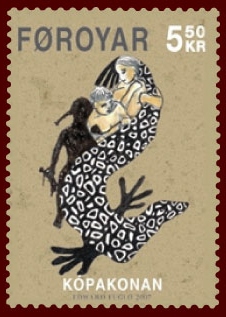
Selkies, archaeologists and poets


Edward Fuglø, Postverk Føroya (faroestamps.fo),
[Public domain], via Wikimedia Commons


I have often been touched by stories of the selkies, seals that can take human form. Tales of these creatures have been common in the folklore of the islands and coastal mainland of northern scotland and farther north, with a series of stamps being produced in the Faroe Islands illustrating some of the legends. Although romanticized in most modern re-tellings, the stories often had a sinister undertone in traditional narratives, the most common of which seems to have been the capturing of a selkie woman for a wife by a human fisherman. It was said that they came out of the sea and shed their skins and were then vulnerable to capture if a man could take the skin and hide it away somewhere. Often a selkie wife would bear several children to the fisherman before finding her skin and escaping back to the sea while he was out fishing. In other stories a human woman takes a selkie lover.

The stories in their sentimental form are not hard to come by but some grittier accounts of the contexts of their telling may be found in works such as David Thomson's The People of the Sea . There is also some interesting context for the possible antiquity of these legends in a recently published book Britain Begins by the archaeologist Barry Cunliffe where he refers to mesolithic deposits in the Hebrides where human finger and toe bones have been placed next to seal flippers in what appears to be "a deliberate act of association".

I recently encountered the following poem in the collection The Wrecking Light by Robin Robertson, a poem dedicated to John Burnside whom I have discussed on this blog before. It engages with the selkie stories in a characteristically bleak way, but also with a use of imagery and a choice of diction that shows him at his tactile best. I shiver when I read such stuff:

At Roane Head

You’d know her house by the drawn blinds –
by the cormorants pitched on the boundary wall,
the black crosses of their wings hung out to dry.
You’d tell it by the quicken and the pine that hid it
from the sea and from the brief light of the sun,
and by Aonghas the collie, lying at the door
where he died: a rack of bones like a sprung trap.

A fork of barnacle geese came over, with that slow
squeak of rusty saws. The bitter sea’s complaining pull
and roll; a whicker of pigeons, lifting in the wood.

She’d had four sons, I knew that well enough,
and each one wrong. All born blind, they say,
slack-jawed and simple, web-footed,
rickety as sticks. Beautiful faces, I’m told,
though blank as air.

Someone saw them once, outside, hirpling
down to the shore, chittering like rats,
and said they were fine swimmers,
but I would have guessed at that.

Her husband left her: said
they couldn’t be his, they were more
fish than human, said they were beglamoured,
and searched their skin for the showing marks.

For years she tended each difficult flame:
their tight, flickering bodies.
Each night she closed
the scales of their eyes to smoor the fire.

Until he came again,
that last time,
thick with drink, saying
he’d had enough of this,
all this witchery,
and made them stand
in a row by their beds,
twitching. Their hands
flapped; herring-eyes
rolled in their heads.

He went along the line
relaxing them
one after another
with a small knife.

It’s said she goes out every night to lay
blankets on the graves to keep them warm.
It would put the heart across you, all that grief.

There was an otter worrying in the leaves, a heron
loping slow over the water when I came
at scraich of day, back to her door.

She’d hung four stones in a necklace, wore
four rings on the hand that led me past the room
with four small candles burning
which she called ‘the room of rain’.
Milky smoke poured up from the grate
like a waterfall in reverse
and she said my name
and it was the only thing
and the last thing that she said.

She gave me a skylark’s egg in a bed of frost;
gave me twists of my four sons' hair; gave me
her husband's head in a wooden box.
The she gave me the sealskin, and I put it on.


PLYGAIN


Some time ago I was invited to submit a poem for an exhibition on the meaning of Christmas. The idea was the reverse of the more common process of a poet writing about a work of visual art. Poems were submitted by a number of writers and then different artists took up their chosen poems as a theme for a visual production. The result is an exhibition of the poems (mostly in Welsh but with a few in English) and the works of visual art at the MORLAN multi-faith arts centre in Aberystwyth.

I chose the theme Plygain (from the latin pulli cantus - 'cockcrow'), a traditional Welsh form of carol service which developed from the pre-Reformation midnight mass with an emphasis on the return of light.

The exhibition opened recently with a chaired debate in Welsh at the Morlan centre on the meaning of Christmas as displayed in the exhibited works. One of the thematic speakers in the debate was Damian Walford Davies who suggested that most of the contributions necessarily 'disturbed' the idea of Christmas, undermining it in order to return - in some cases - with a renewed sense of faith in the significance of the festival

In my own case I had chosen to structure my poem around a 15th century carol addressing 'Yule' as a character. This had no Welsh provenance but did seem to be in keeping with the thematic significance of the Plygain service. I also tried to capture the fact that, as T.M.Owen puts it in his book Welsh Folk Customs "Christmas has changed gradually from an intensely social occasion … to one of family celebration in the seclusion of private houses." This suggestion was also implied for me by the visual image produced by Gareth Owen to illustrate the poem. He produced a triptych of three different constructions, each of a row of three windows to accompany Nadolig Gwyn by Myrddin ap Dafydd, Ym Mwlch y Blynyddoedd by Mererid Hopwood and my own poem. Here the placing of the electric lamp outside the central window implicitly places the light out in the night where the communal procession referred to in the poem is taking place.


PLYGAIN

Song before cock crow in the stillness
Of Midwinter when the darkness
Lingers long before the Sun is seen.

By diverse ways the singers come
To the place of praise, carrying
Bright candles, holly-green and ivy-green.


Welcome Yule, thou merry man
In worship of this holy day.
Welcome Yule, Welcome Yule.

Welcome be thou Heaven King
Born on this blessed morning
To thee Welcome we will sing.


Words and music woven into light,
Bright voices gathered against the dark
Singing of a new life to be born.

Hear the stillness ring with song,
See the darkness glow with light
Before the slow unfolding of the dawn.


(inset verses adapted from a 15th century carol)
***
Poets that are part of the exhibition are: Myrddin ap Dafydd, John Barnie, Tudur Dylan, Menna Elfyn, Greg Hill, Mererid Hopwood, Meirion MacIntyre Huws, Rhys Iorwerth, Mike Jenkins, Dafydd Pritchard, Eirug Salisbury.

The artists are: Cefyn Burgess, Marian Delyth, Anthony Evans, Carwyn Evans, Iestyn Hughes, Ruth Jên, Tegwyn Jones, Gareth Owen, Gareth Roberts, John Rowlands, Diane Williams.